


Stories we need to hear and those that hear us!
- Lunatica
- Apr 19, 2021
- 10 min read
Hey you all, welcome back. In this blog, I am going to be mentioning all my art stories that I posted on my Instagram account. And, I will be using my own artwork to express these stories. I have worked on these for over a month, and each was painted using mostly watercolour and seldom details were made using acrylic.
These stories are who we all as Indians are made up, especially Hindus. Most of us are born in this rich culture and we are so unlucky that so many stories are unknown and unheard, as if they didn't matter or were not interesting. We continue to ignore many stories as we focus on the mainstream characters and fight. So, I began this series on my Instagram that would help me grow in watercolour painting while still offering some research and value to the audience.
I chose 'Surpanakha', the hurt sister of Raavana, as my first choice. And let's find out how I wrote the story for her.
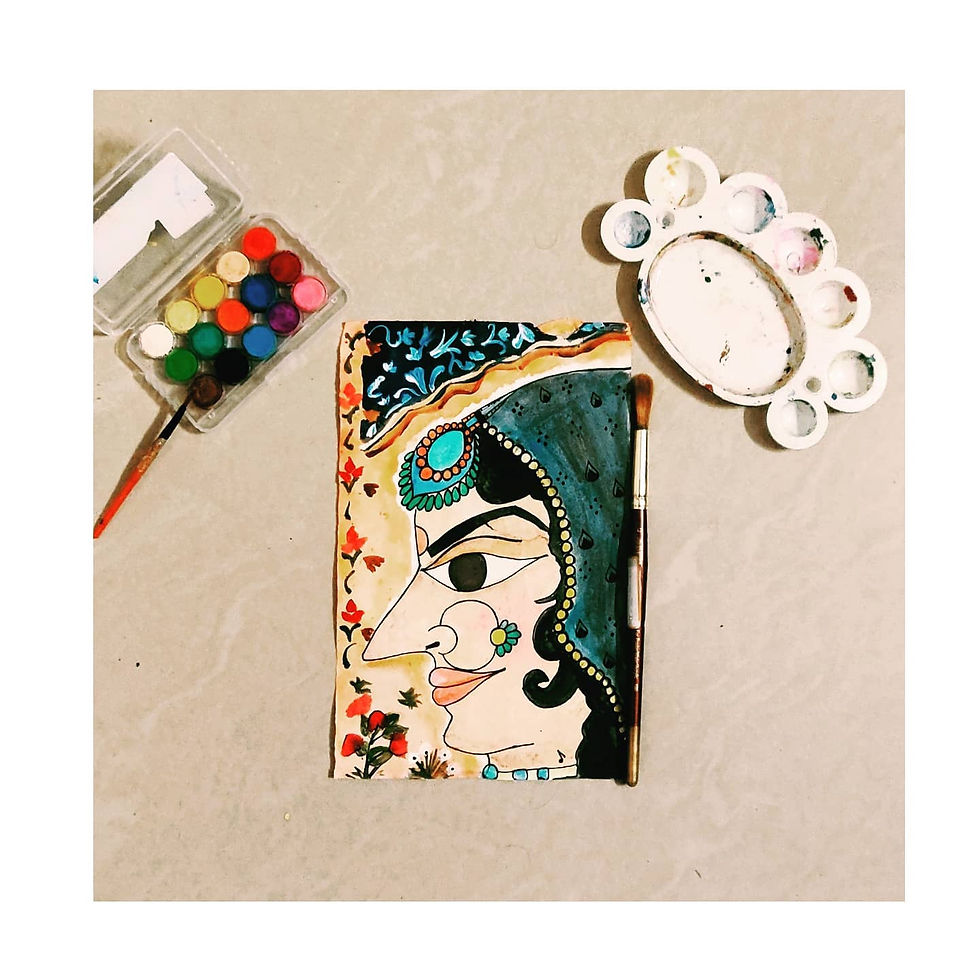
Sūrpaṇakhā, ~~' she whose fingernails are like winnowing fans'), also known as Meenakshi, is a character in Valmiki's epic, the Ramayana, and appears in the other versions of the epic. She is the sister of Lanka king, Ravana, and the daughter of the sage Vishrava and Rakshasi Kaikeshi. Shurpanakha's role in the original epic is small but significant.
This is the definition as per Wikipedia. Surpankha is first in my underrated Indian mythological characters.
She is the spirit of the women who does wrong despite knowing the right, for the purpose of just revenge or hurt.
Hope we all demolish such intentions in our hurt when in pursuit of love or life.
This painting is my first in Mughal style drawing.
Let us move on to the next story. I took 'Amba'
~Amba as Shikandini or Shikandi~
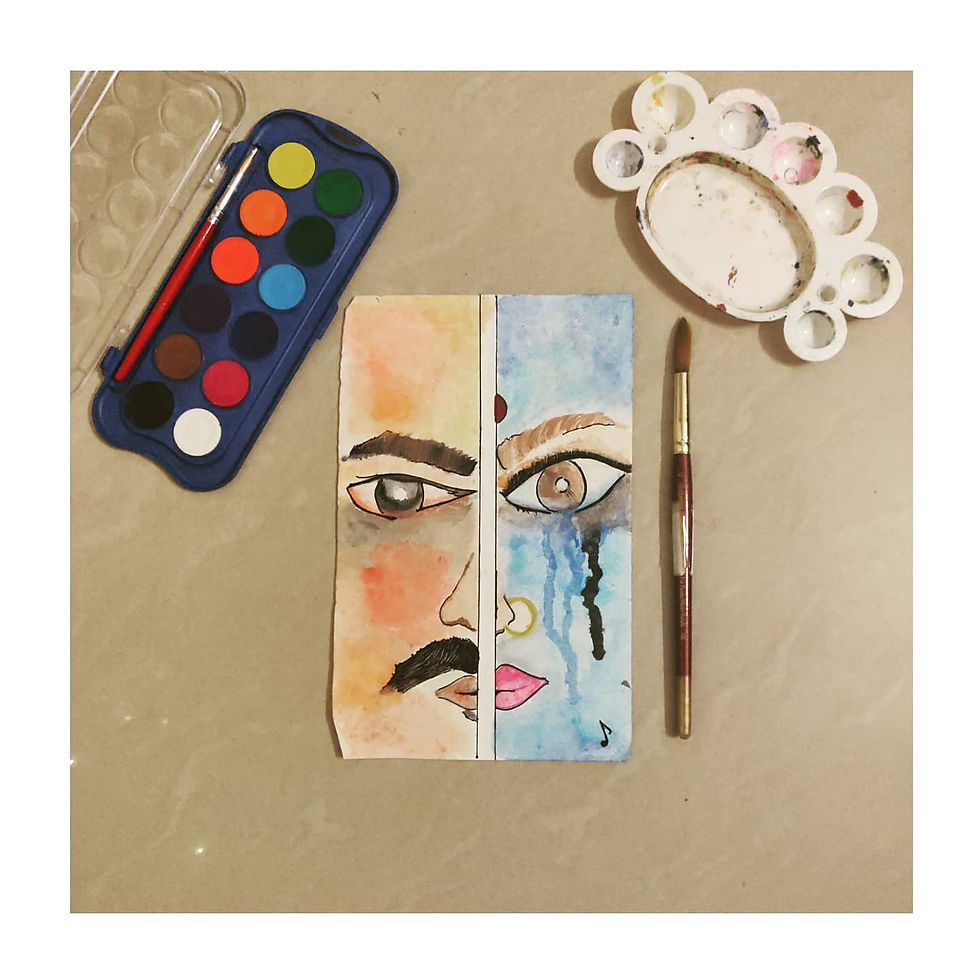
In some versions she transforms into a complete male, in some versions of Mahabharat, she is a eunuch.
Despite the controversies, she is the symbol of 'what broken heart's promise bring to the world'.
'Amba is the eldest daughter of Kashya, the king of Kashi and the sister of Ambika and Ambalika. Amba was abducted by Kuru prince Bhishma and holds him responsible for her misfortune.' This is the story by Wikipedia. On that same note since the prince rejects her as Bhishma kidnaps her for his half-brother for his half-prided oath to protect the Kuru dynasty and be true to it. Salva, who was secretly in love with Amba, and wished to marry her, was defeated yet spared for life by Bhishma. He refuses Amba due to the very same insult. She pleads Bhishma to marry her instead, who due to his celibacy, pushes her to another rejection. Owing to the fact that Bhishma was the sole reason for the confusion and rift between the lovers and her rejection and loneliness, she takes an oath to bring him to death one day. She is reborn as Raja Draupad's daughter 'Shikandini', sister of 'Draupadi' and eventually transforms to 'Shikandi' who helps Arjuna in defeating him to death.
Celibacy, oath and action for all wrong reasons like that of Bhishma, brings the end, one way or other.
'Shikandi' is one of Mahabharat's most underrated character.
She is one of the first 'transformation' Indian cultures has openly accepted, talked about and respected, making us question whether we treat our fellow #transgenders with the same respect or not.
She, of course, is the second part of my series.
'Urmila', from Ramayana is not known to much of us. She is Indian sleeping beauty and we know nothing of her.
I used only watercolours in this painting.
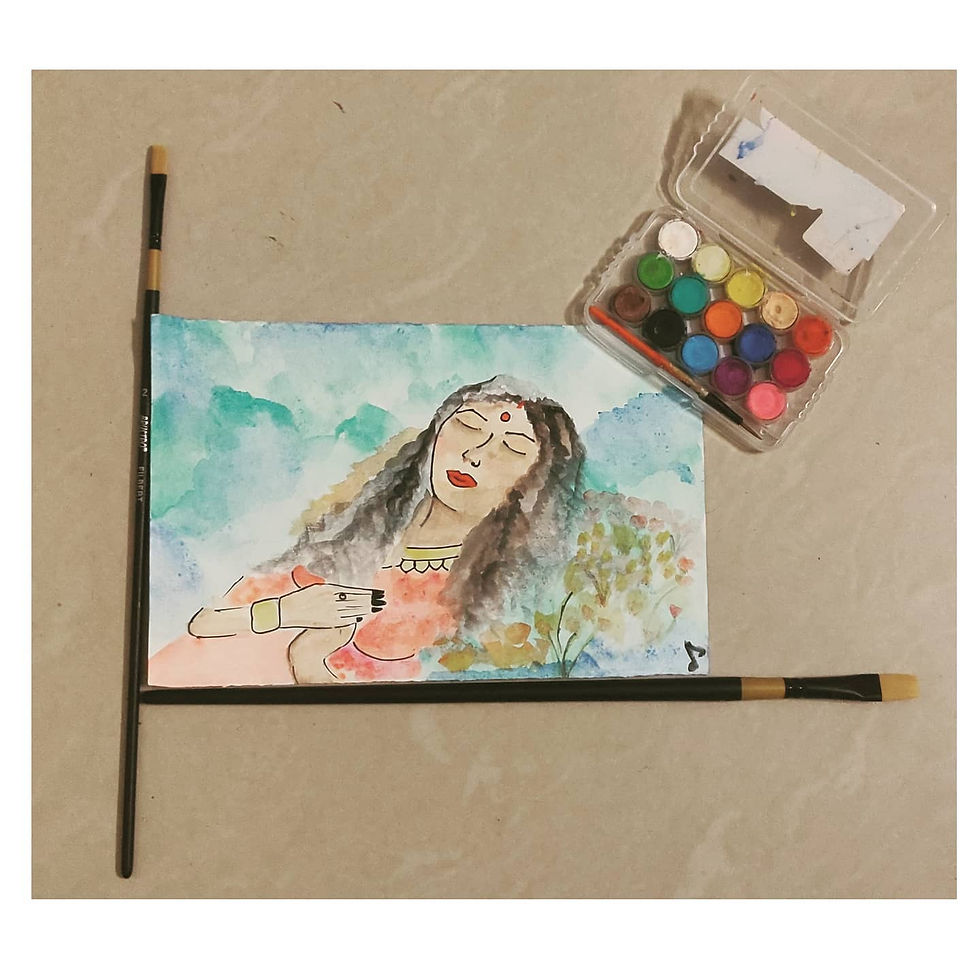
We all know the duty-bound and eternal grace of Rama, his respectful brother, Lakshmana, the epitome of sacrifice and love, Sita and even the half-brother, Bharata for his brotherhood.
But we have never heard tales of our own sleeping beauty, who stood for what she believed and loved. She is Urmila.
Grown in royalty, just like Sitē, even she was all set to leave Ayodhya with Lakshmana. However, duty-bound and in brother's love, Lakshmana stated 'Dear, if you accompany me in this trek, I shall be distracted from my service to my brother and sister-in-law.' Disheartened and sad, Urmila let Lakshmana go.
Following these events, in the deep forest and time-bound exile, the otherwise agile Lakshmana, one day felt dizzy and sleepy while doing his usual duties of guarding his brother against any danger. This night was bound to fail him when he recognised this Goddess who tried to trick everyone to sleep. 'Nidra-Devi', the sleep-inducing Goddess was standing before him. Lakshmana in all humbleness told her his responsibility and requested her to go to Ayodhya where his 'other half' would happily accept his part of sleep.
Urmila, true to her husband's word, did exactly as Nidra Devi was told and slept for 14 years.
~~~
Upon Rama, Lakshmana and Sita's return to Ayodhya, during the Ram's Rajyaabhishek, Lakshman lets out a laugh. Thinking he was hysteric, everyone questioned why would he do that in a Royal court? To which he childishly announced that Nidra Devi has returned to seek his promise, and falls asleep. During the same time, Urmila awakens to take his place in the court.
~~~
Urmila is not only an example of patience but also of 'sativratha' wife, just like Sita. It's sad we do not know her as much as we know other Ramayana's character, which is why she is my third art in the series of exploring underrated Indian mythological characters.
Our fourth character is Kannagi. We all grew up in an environment where women meant fragile, soft and flower-like delicate. But, I grew up listening to a woman who loved her husband (wait for the irony) so much that for the wrong that happened to him, punished a whole city.
~Kannagi; The end of Madurai~
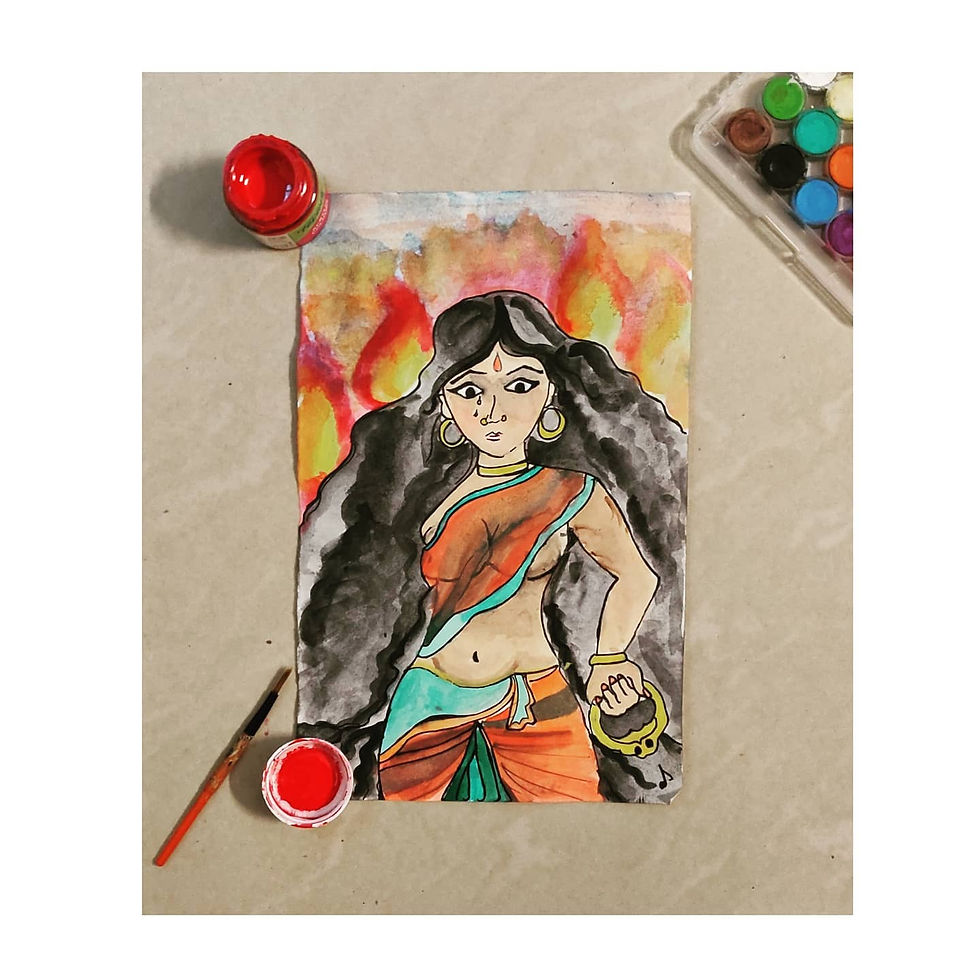
"Kannagi is described as the chaste woman who stays with her husband despite his unfaithfulness, their attempt to rebuild their marriage after her husband had lost everything but repented, how her husband is falsely framed then punished without the due checks and processes of justice. Kannagi proves and protests the injustice, then curses the king and city of Madurai leading to the death of the unjust Pandyan King of Madurai, who had wrongfully put her husband Kovalan to death. The society that had made her suffer, suffers in retribution as the city Madurai is burnt to the ground because of her curse."
Kannagi could be taken for the stupidity of staying with her unfaithful husband or for her bravery to stand against the wrong infront of those in power. It is all a game of perspective. This fourth image in my underrated Indian mythological characters is a tribute to South India for its rich outstanding and outspoken women of the old time.
I took her since her story is perhaps only known down in the south, the rest of the country doesn't even know what and where Madurai is.
5th story is about Vasuki. 5 facts about Vasuki.
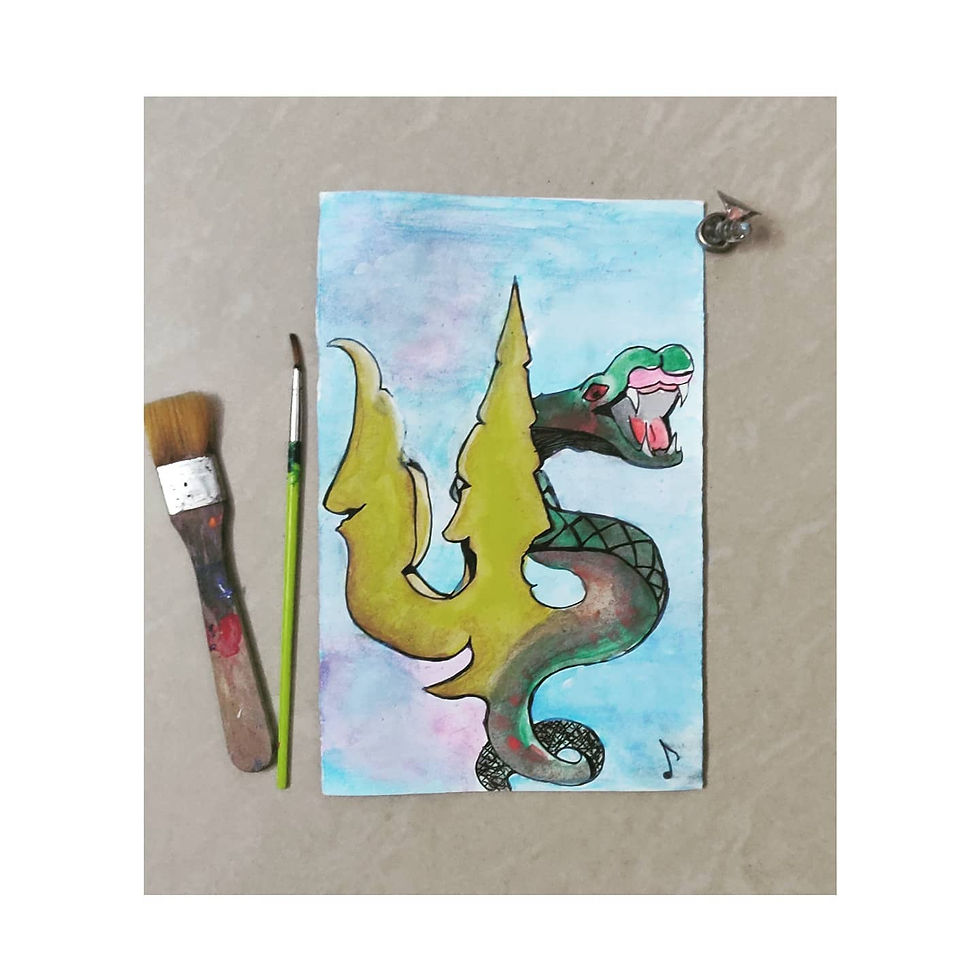
1. He is Shiva's strength just like Adisheshan is of Vishnu's.
2. He once became Shiva's Trishul, the concept of this drawing is based on that.
3. He and Sheshnag or Adisheshan are said to be brothers.
4. He is utterly devoted to Shiva. In such a way that it is said he drank Halahal along with him. Seeing which, Shiva was said to be impressed.
5. Vasuki is also known as the king of serpents.
Why is he in my 'list of underrated Indian Mythological characters?
1. We all know Sheshnag and his loyalty to Vishnu through various avatars. Stories of Vasuki are lesser-known. Might be that you will google him after this. He too is a symbol of devotion and friendship.
2. To be consistent. Consistent in churning the ocean of sea (symbolised by Amrit Manthan) despite the poison (obstacles).
~A love story that is as pure as Radha Krishna's~
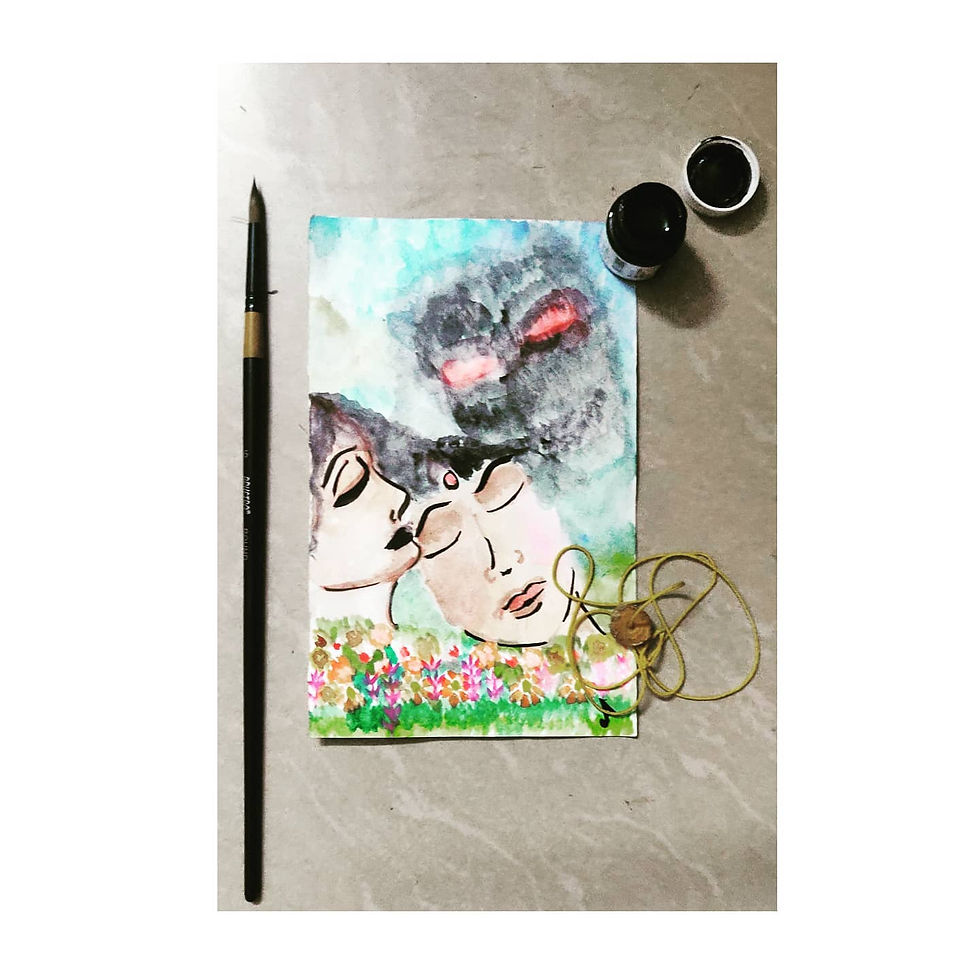
I drew this towards the end of that Sunday as we completed our 'Satyavan Savitri' puja and adorned this small thread pasted in turmeric, symbolising a 'Satya' husband to the unmarried and a long-living one for the married.
This is a puja done in honour of Savitri. Someone who saved her husband got herself, future kids, helped him get his dad's kingdom and eyes and much more.
Even if it's a bit bizarre to think women can be represented as so powerful, let us also take a moment to appreciate Satyavan's love for her and his parents.
Savitri is symbolic of feminism, love and devotion to Shiva and her husband. She leaves all her kingdom, wealth and lifestyle to actively chose to live Satya's way. As cliché as it sounds, she didn't need to do it. She did it willingly and happily because her content was with Satya.
Why are they in my series? Underrated and often ignored from the position of Deva's as they were humans and not much known in North India, are these power couple who deserve much more praise for their loyalty than Ram-Sita (unpopular opinion, don't kill me).
She is an image for the brain, not just all these emotional traits, as she tricks the death God, Yamraj himself into granting her the wishes she deserves.
Moral of the story: I am not sure if Yamraj will ever try to take you or if he exists at all, and for that matter, if a perfect husband exists, but I know Savitri does. In knowing you can use your brain from getting out of any DEADLY situation.
Moving on, we all know Krishna, Rama and we worship them so much. They are like common friends to us.
As both, famous for their stories and the fact that they are said to be an incarnation of Lord Vishnu.
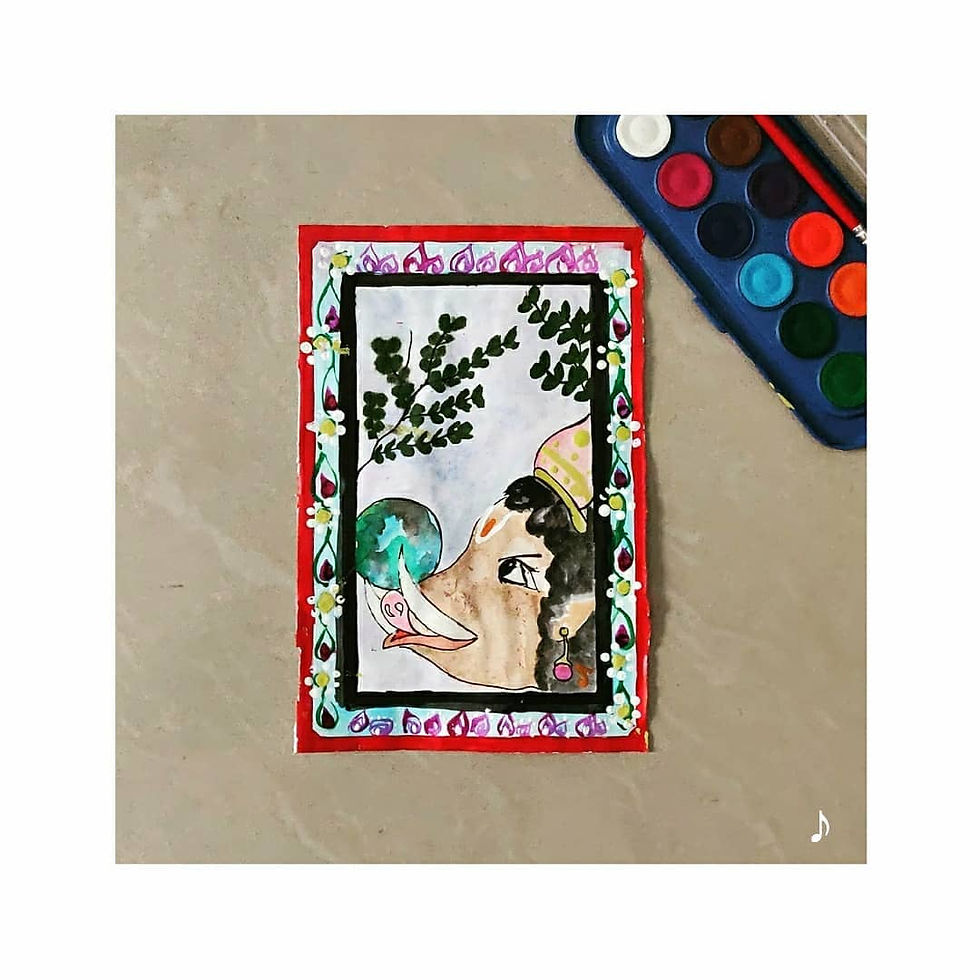
However, in this next painting for my #underratedindianmythologicalcharacters series, have chosen Lord Varaha Murti as my art piece. He has a body of an animal we wouldn't imagine worshipping, the wild boar or pig.
Maybe the stories had it like this so we respect, and not eat, what we see around us.
Lord Vishnu is famous for his presence around all animal and worldly bodies. He has blessed a pig, tortoise, and whatnot.
Not only this, this avatar of Vishnu is the 3rd out of his ten. He does so to save the world, by carrying it in-between his sharp tusks, saving it from drowning. But, why was our planet drowning anyway? Here comes the interesting part, Hiranyaksh, also known as Hiranyanetra was an oppressive Asura who attacked the heavens and thereafter kidnapped and attempted to destroy the earth goddess. In some stories, this earth goddess is none other than a form of Lakshmi, Vishnu's other half. And surprisingly the destroyer of Hiranyash, later becomes a sore eye to his brother, Hiranyakashpu and sister Holika, thereby kindling another series of stories and avatar.
Now, we move to our second last painting in our series. We live in a country where Ganga is the washer of sins, mother of Bhishma and another source of calm to the destroyer of evil, Shiva.
We live in a country where we worship the river we emerge dead bodies in.
As stories, these were designed to encourage the country to be decent to the nature that is a source of so many things.
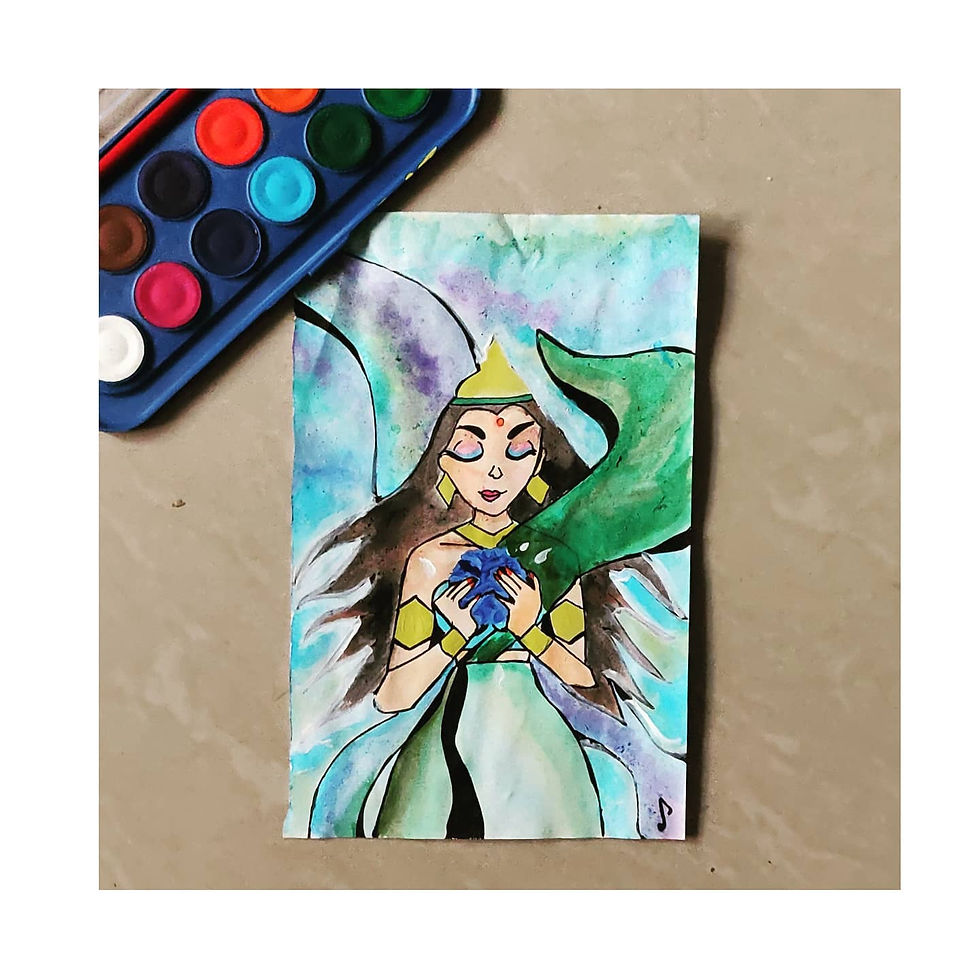
Ganga was portrayed a mother. And she also manages to be in the 'jata' of the Lingeshwarar, making it obvious that the platonic relationship controls his temper and his locks, control her flow, preventing her from overflowing and causing destruction.
We live in a country that worships cows, tries to not hit or bother a cow and yet supports indirectly the smuggling of cow, just because in earlier times it was healthy to have cow milk. I love how we are blind eye to issues like these for our own comfort. It is completely different from taking care of a cow at your own house and treating it like a pet and not a machine...
We live in a country where river water needs active cleaning.
"Ab ganga se apne paapo ko dhone ka waqt hai,
Ganga mein paapo ko dhone ka nahi."
Times have changed.
Floating dead bodies, washing clothes in a natural river, putting garlands and flowers in fresh water and peeing, needs to be addressed and stopped.
This is my second last painting in the series and I wanted to give one solid message and hence, didn't include an actual story in this one. She is not just underrated but undervalued. Water scarcity is a real issue that is happening and will continue to worsen as we harm her and ourselves more.
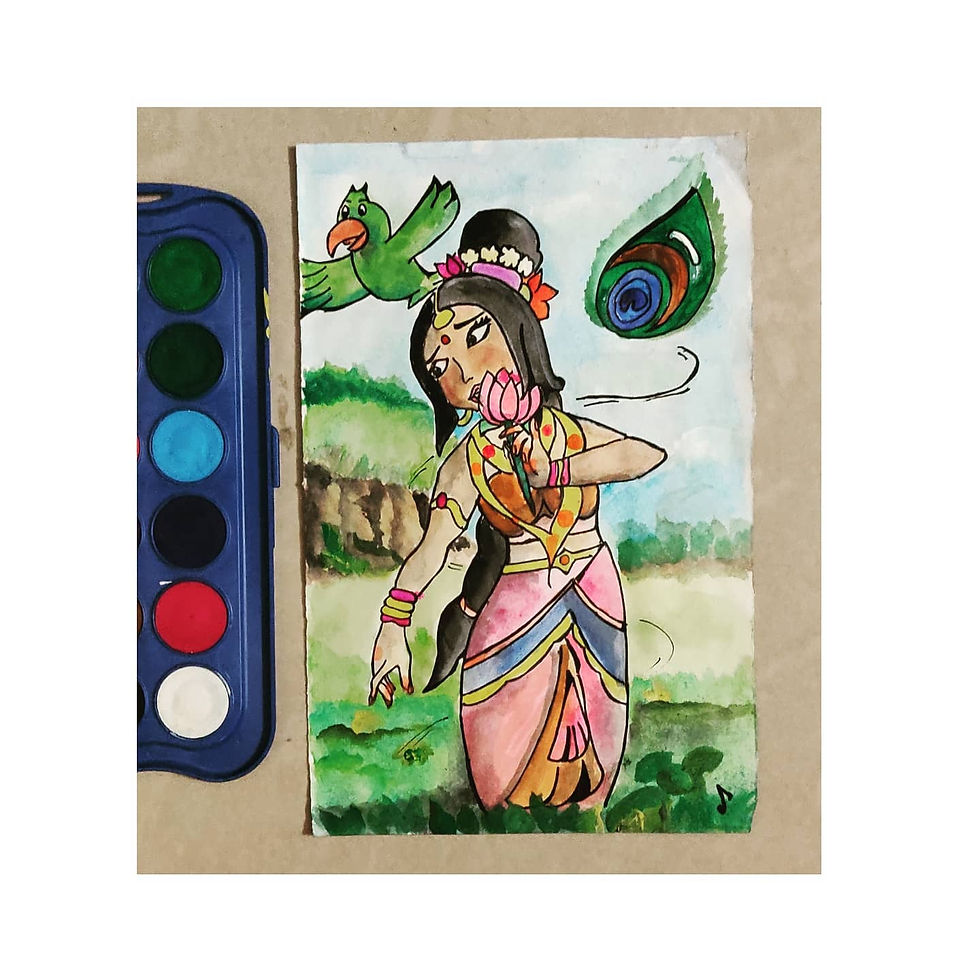
Finally my favourite of the whole series. Last but not at all least.
बिरहा का दुःख काहे हो बांकिये
दिखे मोहे तू ही जो जिया में झांकिए
पल पल गिनती हूँ आठों ही पहर
कितने बरस हुए मोहे हाँ किये!
~Chali Kahani, Tamasha
We all have known stories of love, and the wait. A wait, so long that even after togetherness it doesn't end. But only ends with salvation. The story that echoes in Laila Majnu, Heer Ranjha, Mirza Sahiba, Sohni Mahiwal, Radha Krishn, Meera Krishn, Rukmini Krishna, Sita Ram and much much more subtle and tragic ones, that we don't even know of.
This is my last post and an ode to a story that I grew up by first watching actress 'Kutti Padmini' perform alongside 'Shivaji Ganesan' in 'Thirumal Perumai', an old south Indian movie singing praises of Lord Vishnu, the one who according to Hindu mythology, was the essence of all being, and one who sustains the world.
I grew up idolising his powers and love in every man I saw and fell for. Like the forlorn Lakshmi's avatar 'Andal' did as she was found a girl in lotus to a 'Vishnu bhakt'. She grew loving him, just like Meera, and eventually thought low of as she tries to adorn her lord with the flower she wore, and much more. Only in the end to be revealed 'she was his' all along and he, hers too.
Today I might not be a theist who believes so strongly to think I will be taken back in his arms by some God from above. But, these stories and the immense love I felt for a personality that 'could have been' or 'did exist' as much as Sherlock, Anne, Liesel did. . These small stories are part of who I was and how I became who I am today.
As much as I want to say even love is something chemically created, I would like to think otherwise.
With this, I finish the series of #indianunderratedmythologicalcharacters
Even though all the characters are separated by eras and dimensions, these are all joined by a sense of togetherness of this land, and the fact that they all have survived the time.
And, the song that played here while you got into the page, is an underrated A R Rehman gem from the movie 'Tamasha'. Even though other songs from the movie, like 'Agar Tum Saath Ho' got so famous, this song was always left alone. However, the song explains the context of our blog and the essence of the movie. Let me know if you'll enjoyed the blog.
Thank you
Love
Lunatica

Comments